Findings, Nerdery, Slack

More Brain, the tantalizing promise that persists

I was recently looking for a better writing tool and came across Obsidian, a “powerful and extensible knowledge base that works on top of your local folder of plain text files.”

I saw this on their homepage.

And thought to myself, that seems familiar. So I went searching through some archives and found –

That second screenshot is from August, 2013 when I was working with the team at Slack and we were figuring out our positioning prior to launching.

Now, I don’t mean this post to say that Obsidian are ripping off a Slack that never existed because they’re not. Slack launched with a different homepage and positioning, and the chance that anyone saw that Slack copy above is pretty near nil.

What I do mean to point out here though is that the promise of a “second brain” or a “scalable, infinite brain” is a tantalizing thought that persists still today, pretty much unsolved.

And will we ever solve it? Maybe?

And if we did ever solve it, my sense is that it would change what it means to be human.

There is a reason the zombies seek and eat “Braaaaains!”

Standard
Findings, Vancouvering

Robert Davidson at Vancouver Art Gallery

Last week I had the chance to visit the Vancouver Art Gallery’s show Guud san glans Robert Davidson: A Line That Bends But Does Not Break and I found it exceptional.

I remember the first time I saw Davidson’s work at Coastal People’s when searching for wedding rings, and I have lazily followed his work for the 11+ years since. But I had no real sense of the full range of his powers, the trajectory of his work or the scope he has invented in what’s possible for Haida art.

A Line That Bends But Does Not Break is a perfect title for the experience. Since the late 1960s Davidson has been creating exceptional art, starting with traditional forms to a level of mastery, and then pushing the boundaries to new inventions. Abstraction is introduced. Colours grow vibrant and divergent. New materials create new options for form.

Exceptional and memorable. Thank you.

Standard
Findings

SOFEX: The Trade Show for the Business of War

“You know, it’s weird, man. It’s like everybody’s real cordial with each other. But, at the end of the day, we’re, like, buying weapons to destroy each other. I don’t want to, like, sound too liberal or anything. But it’s really not glamorous. This s*** f***** kills people.”

Amazing web documentary on SOFEX, the bi-annual trade show at the centre of the business of making war.

Impressive stuff from Vice. I remember when they were a punky zine in Montreal.

Standard
Findings, Inside Voice

It is not the critic who counts

I like this.

It is not the critic who counts; not the man who points out how the strong man stumbles, or where the doer of deeds could have done them better. The credit belongs to the man who is actually in the arena, whose face is marred by dust and sweat and blood; who strives valiantly; who errs, who comes short again and again, because there is no effort without error and shortcoming; but who does actually strive to do the deeds; who knows great enthusiasms, the great devotions; who spends himself in a worthy cause; who at the best knows in the end the triumph of high achievement, and who at the worst, if he fails, at least fails while daring greatly, so that his place shall never be with those cold and timid souls who neither know victory nor defeat.

— Theodore Roosevelt

Found on Destraynor.

Standard
Findings, Nerdery, Stories

Ernest Hemingway Quotes of Hard-Won Wisdom

Been thinking a lot about Hemingway quotes of late. Collected a few particular favourites here, below.

If people bring so much courage to this world the world has to kill them to break them, so of course it kills them. The world breaks everyone and afterward many are strong at the broken places. But those that will not break it kills. It kills the very good and the very gentle and the very brave impartially. If you are none of these you can be sure that it will kill you too, but there will be no special hurry.

— A Farewell to Arms

Never mistake motion for action.

The shortest answer is doing the thing.

The best way to find out if you can trust somebody is to trust them.

All my life I’ve looked at words as though I were seeing them for the first time.

The first draft of anything is shit.

We are all apprentices in a craft where no one ever becomes a master.

In our world of excess and super abundance of words, entertainment, distractions and information, the spareness and clarity is refreshing.

Each quote a refreshing breath of hard-won wisdom.

Standard
Findings, Inside Voice, Nerdery

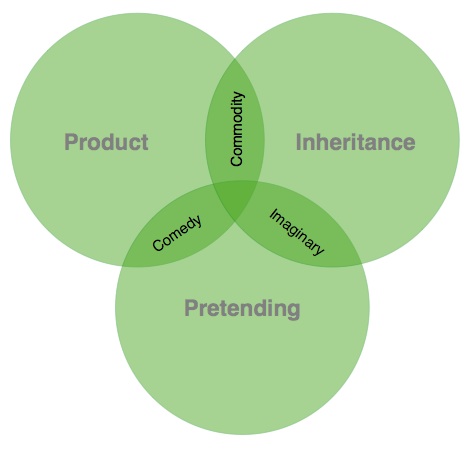
A model for creating great advertising: inheritance, product, pretending

A model for understanding the key ingredients of great advertising: inheritance, product, pretending.

Have I’ve spoken to you about this before?

If so, now I’m following up with some early-stage draft ideas. If not, here’s the background.

I’m working on a bit of a model for creating great advertising.

My idea is that great advertising emerges from 3 things: an inheritance, a product and pretending. The image above presents a conceptual model.

The idea rose from reading this post by Russell Davies on pretending.

When adverting can hit the middle of this model, it succeeds. Big time.

The trouble is: everyone has their own version of the above model in their head. That’s what makes good advertising so tough to do.

Everyone has their own frame of reference (inheritance), usage patterns (product) and imagination (pretending). So everyone’s experience of the advertising is different.

Okay, that’s assumed. But can this model help us understand the ingredients needed to get beyond that unique experience and to a common experience?

That’s what I’d like you to help me with.

I’m trying to work out some clever, salient things to say that make sense of this idea and this model. I’d love to hear what you think about the model overall and about how useful it is.

Best,
James@adhack.com

(and comments way below too!)

Standard
Findings, Inside Voice, Nerdery

The great game of Moral High Ground

Ask Metafilter asks: What clever relationship “hacks” have you come up with?

Stuck on an island replies:

At last it is time to reveal to an unwitting world the great game of Moral High Ground. Moral High Ground is a long-playing game for two players. The following original rules are for one M and one F, but feel free to modify them to suit your player setup:

1. The object of Moral High Ground is to win.

2. Players proceed towards victory by scoring MHGPs (Moral High Ground Points). MHGPs are scored by taking the conspicuously and/or passive-aggressively virtuous course of action in any situation where culpability is in dispute.

(For example, if player M arrives late for a date with player F and player F sweetly accepts player M’s apology and says no more about it, player F receives the MHGPs. If player F gets angry and player M bears it humbly, player M receives the MHGPs.)

3. Point values are not fixed, vary from situation to situation and are usually set by the person claiming them. So, in the above example, forgiving player F might collect +20 MHGPs, whereas penitent player M might collect only +10.

4. Men’s MHG scores reset every night at midnight; women’s roll over every day for all time. Therefore, it is statistically highly improbable that a man can ever beat a woman at MHG, as the game ends only when the relationship does.

5. Having a baby gives a woman +10,000 MHG points over the man involved and both parents +5,000 MHG points over anyone without children.

My ex-bf and I developed Moral High Ground during our relationship, and it has given us years of hilarity. Straight coupledom involves so much petty point-scoring anyway that we both found we were already experts.

By making a private joke out of incredibly destructive gender programming, MHG releases a great deal of relationship stress and encourages good behavior in otherwise trying situations, as when he once cycled all the way home and back to retrieve some forgotten concert tickets “because I couldn’t let you have the Moral High Ground points”. We are still the best of friends.

Play and enjoy!

The great game of Moral High Ground

Standard
Findings, Nerdery

Rumours, Belief and How Human Culture Trumps Technology

This Internet thing was supposed to help inform people — universal access to inexhaustive information.

But, that’s not quite what’s happened or happening.

So far, more than half a dozen lawsuits have been filed alleging that Obama is not a “natural born” citizen. One plaintiff, an Army reservist from Georgia, argued in court that he couldn’t be sent to fight in Afghanistan because the military lacked a Commander-in-Chief. In a poll released over the summer, twenty-eight per cent of the Republicans surveyed said that they did not think Obama was born in the U.S., and thirty per cent said that they were unsure, meaning that fully half took birther ideas seriously enough to doubt the legitimacy of their government. When a video of the woman in red was posted on YouTube, it quickly went viral; within a few weeks, it had received some eight hundred thousand hits.

That such a wacky idea should be so persistent is, to put it mildly, disquieting. Here we are, quadrillions of bytes deep into the Information Age. And yet information, it seems, has never mattered less.

According to Cass R. Sunstein, the situation was to be anticipated.

The Things People Say — Rumors in an age of unreason by Elizabeth Kolbert documents the built in biases we have for information gathering, belief development and social reinforcement.

“The acquisition of knowledge is, as Sunstein points out, a social process: it is shaped by language, by custom, and, since the Enlightenment, by certain widely accepted standards of evidence and rationality.”

Except the Internet makes it more possible than ever to filter the information we receive and compound “group polarization.”

Standard