Slack, Stories

Launching A Slack Story on Quitter’s Day

Apparently today, the second Friday of the new year, is called Quitter’s Day. It’s the most popular day of the year for abandoning new year’s resolutions.

So, what better day to launch a new project? (Or, better yet, to quit not launching this project.) Here goes.

Today I’m starting to tell people about A Slack Story. It’s a writing project I’ve been working on that tells 3 stories:

  • A personal story. As the ninth person to join Slack I really didn’t know what I was getting in to. The journey that followed covered 7 years, 5 jobs and multiple continents. It’s a story of relationships and doubts and rollercoaster emotions and failures and learning to do what needed to be done by doing it.
  • A comeback story. Slack didn’t start as a success. It started as a failure of a video game riddled with burned cash, layoffs, disappointment and tears. Then, nearly the same band of outsiders regrouped from that failure, and transformed a failed game into a blockbuster workplace tool.
  • A business / tech story. The business, funding, fundraising, venture capitalists and capitalism that helped create companies like Slack and propel it to be worth $28-billion dollars in less than 9 years.

I’ve already shared early drafts of chapters with ~50 readers and their responses have been enthusiastic and incredibly helpful and deeply appreciated. The work is much better as a result. Thank you to them.

Now on Quitter’s Day I think we’ve got something going and there’s no better time to get out of the way.

Why I’m doing this

It’s a good question. And one that I ask it myself often enough. So fella, why?

To tell a story. To thank some folks. To share some lesson I think we learned along the way. To try to understand the advantage of the place I happened to be in at the time I happened to be there. To keep milking that Slack cow.

To celebrate and share the excellent people at Slack. I met and worked with remarkable people and collectively they created a remarkable company.

To give some insight into my journey in tech, business, startups and beyond so it helps others on their own journey. Could your journey be like Slack? Maybe, partially, but incredibly unlikely. Could there be lessons from Slack? I’d vote yes.

To entertain family and friends and acquaintances and myself. Seriously. It’s been so much fun writing these stories. I have found myself laughing out loud while working. I hope others find themselves having some fun too.

Why might you care?

Because I think it could help. There’s so much good work and high hope going into speculative startup ventures, I’d like to see them succeed at a higher rate.

  • Because I talked with Mishti at a startup called Clay the other day and she was unsure of how she could get their team all behind some product positioning that made sense and allowed them entry to a larger market.
  • Because Emma at HelpTexts is trying to hire a sales person and keen to learn how we did it at Slack – our scoring matrix, our process, how we found and evaluated candidates.
  • Because Mike at ThoughtMetric is building a business through inbound growth and wondering how to think about creating a virtuous cycle to drive new customers, successful customers, referrals and reputation.

In short, I’ve seen how the stories of A Slack Story can help people make sense of their own working worlds. Or at least feel like they’re not alone in their struggles. And I want to help more people.

And it’s to entertain. I hope you agree and enjoy.

What you can expect

Here’s how I imagine it going and what you get from it all.

Chapters will get published roughly weekly. There’s about 50 chapters so it’ll take about a year to publish.

Chapters will get sent out by email and published on Substack. Here’s the link to subscribe: sherrett.substack.com

If you’re a subscriber, you can comment and ask questions and tell me I’m a loathsome tech bro. It’ll be free too.

Will there be more? Yes. But first, to begin. Let’s go!
Standard
Coaching, Nerdery

249 Workouts in 2024

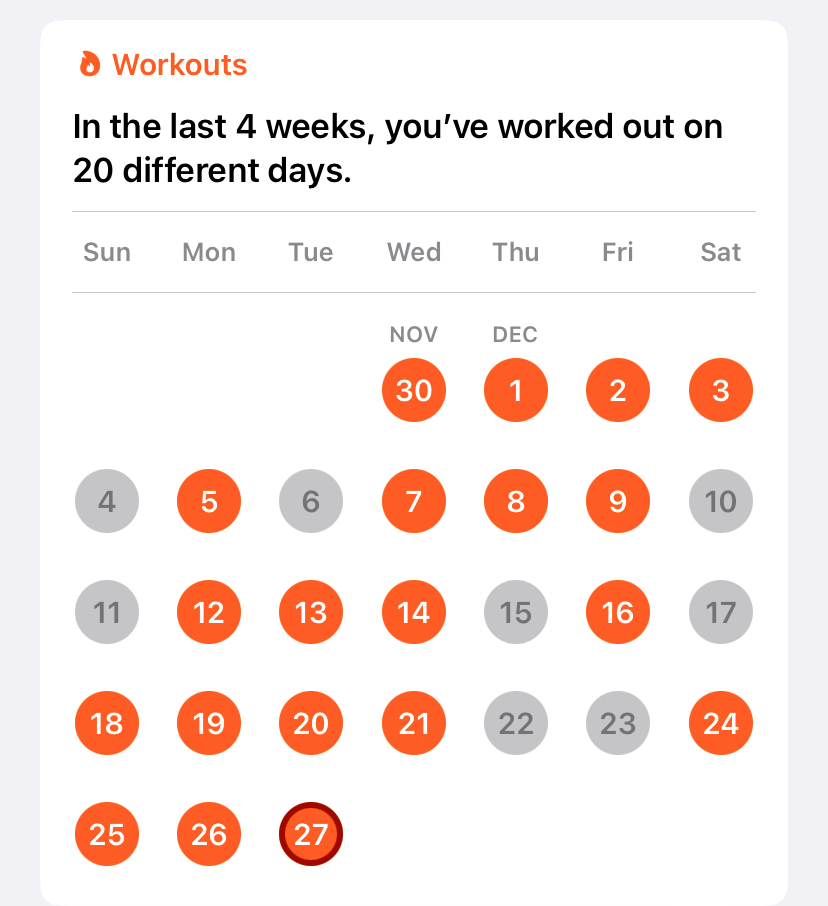
Since 2021 I’ve had an annual goal to hit 200 workouts in that year. It’s 4 workouts per week. If you’re a user of the Apple Health app, it’s hitting 16 workouts on the rolling 28 days view.

That first year I reported on my goal I went into some depth on why I chose 200 workouts and what counts as a workout. I won’t rehash that here because it hasn’t changed too much. The one addition I’d make is that as a parent, showing your kid that fitness is important is important and sets them up for success with their own fitness life.

I did hit my goal that first year, but only by the smallest of margins. December was a rush to push through and see me reach the target. Deadlines!

In 2022 I hit 237 workouts.

In 2023 I hit 246 workouts.

In 2024 I’m happy to report I hit 249 workouts. Somehow this past year was easier to just keep on ticking them off, week after week.

I don’t know that I’ll get higher than 249 workouts in a year. It’s a bit tempting to try to exceed 250, but only really because that seems like a demarcation point. Not because of anything else.

Except maybe the social angle? Every year I challenge my brother to do 200 workouts, and he does them too. So maybe we’ll make it to 250 in 2025. We’ll see!

(PS: Science agrees the best way to do something like 200 workouts in a year is to break them up and track by week: The Secret to Accomplishing Big Goals Lies in Breaking Them into Flexible, Bite-Size Chunks. Good luck with your own goals!)

Standard
Inside Voice, Stories, Vancouvering

Proverbs from Ramada Inn

One thing I sometimes do is just hit random play on my whole music collection. Almost every time I get reintroduced to a gem.

Today I got reintroduced to the audio file embedded above.

It’s an idea from 2008 for a radio advertisement for a hotel chain. We chose Ramada Inn but it could as well have been Holiday Inn or Marriott.

We’ve taken a simple fact of budget or midmarket hotel rooms – that each room comes equipped with a bible in the bedside drawer – and created a hopefully surprising story from it. And I think it holds up pretty well.

Full credit to Monica Hamburg for the main voice acting and to Joe Solomon for the collaboration.

And, if you are wondering about the passage, it’s source is Proverbs, Chapter 7, Verses 15-20, with some updated language. (In the read I made the mistake of saying Chapter 17.)

Standard
Findings, Nerdery, Slack

More Brain, the tantalizing promise that persists

I was recently looking for a better writing tool and came across Obsidian, a “powerful and extensible knowledge base that works on top of your local folder of plain text files.”

I saw this on their homepage.

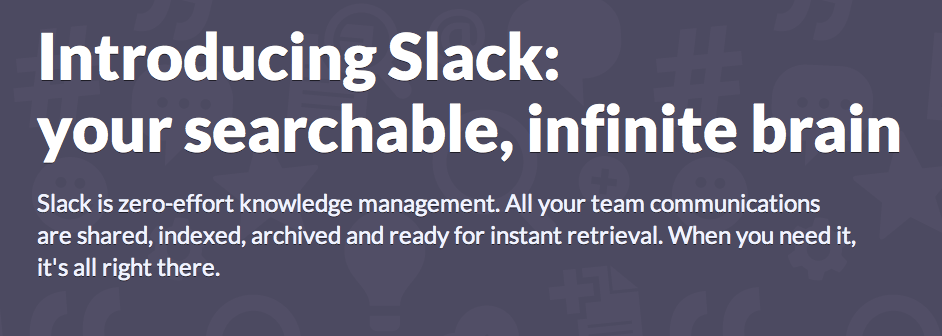
And thought to myself, that seems familiar. So I went searching through some archives and found –

That second screenshot is from August, 2013 when I was working with the team at Slack and we were figuring out our positioning prior to launching.

Now, I don’t mean this post to say that Obsidian are ripping off a Slack that never existed because they’re not. Slack launched with a different homepage and positioning, and the chance that anyone saw that Slack copy above is pretty near nil.

What I do mean to point out here though is that the promise of a “second brain” or a “scalable, infinite brain” is a tantalizing thought that persists still today, pretty much unsolved.

And will we ever solve it? Maybe?

And if we did ever solve it, my sense is that it would change what it means to be human.

There is a reason the zombies seek and eat “Braaaaains!”

Standard
Findings, Vancouvering

Robert Davidson at Vancouver Art Gallery

Last week I had the chance to visit the Vancouver Art Gallery’s show Guud san glans Robert Davidson: A Line That Bends But Does Not Break and I found it exceptional.

I remember the first time I saw Davidson’s work at Coastal People’s when searching for wedding rings, and I have lazily followed his work for the 11+ years since. But I had no real sense of the full range of his powers, the trajectory of his work or the scope he has invented in what’s possible for Haida art.

A Line That Bends But Does Not Break is a perfect title for the experience. Since the late 1960s Davidson has been creating exceptional art, starting with traditional forms to a level of mastery, and then pushing the boundaries to new inventions. Abstraction is introduced. Colours grow vibrant and divergent. New materials create new options for form.

Exceptional and memorable. Thank you.

Standard
Inside Voice

Thank you, Darren Barefoot

My close friend Darren died this past week.

He wrote an excellent (and heartbreaking) message to the world toward the end of his life: They Were All Splendid.

The company he co-founded and ran with his wife Julie Szabo posted the wonderful In Memory of Darren Barefoot.

And many more folks have written warm, thoughtful, caring messages about Darren’s life and what it meant to them. He touched a great many people.

With a few others I had the priviledge of speaking with Darren a few weeks before he died. I knew then that Darren’s time was very limited. Here is what I wrote to share with him.

––

Hold on Tightly, Let Go Lightly

I started to call this “A life…” and then I thought, no, that’s not enough.

The life. This only life that Darren has. The life that is still here, today, in the present. This present we share with him. Now. Here. What we have is now and here and Darren who is still with us.

And Darren, I still hear your voice in me.

“Ahhh, Julie,” he will start. He’ll hold out his hand and say, “You know, I was wondering.” And I remember now most of all, “Hold on tightly, let go lightly.”

His voice is alive in my head, his presence is alive in my mind, his words are here with us today. And I want this moment I have with you to be a thank you for that presence and that voice.

So thank you, Darren, for your voice.

Thank you for what it said when we walked and talked and wondered aloud about anything that came into our privileged wanderings.

Thank you for teaching me about the love of hermiting yourself away in private while remaining committed to an eminent curiosity about the world.

(Darren once told me that this was basically why he started his blog – to write down his research into the things in the world that tickled his curiosity. If only, he had mused, if only he had some researchers to go out and do the work on all the things that tickled his mind.)

Thank you, Darren, for agreeing in 2006 to our first man date to go fishing to Squamish and for letting me outfit you in poorly fitted waders to catch a few fish. 

(Did you really care about fishing? Enough to give it a go that time and about a half dozen more. Enough to indulge your curiosity.)

We talked in the car on that first fishing trip in a way that men going fishing don’t usually talk. We talked about how the music of Van Morrison touched us even though later he had turned out to be a crank. We talked about our respective stories – both of our parents divorced, each of us partnered up with amazing women early on.

As we set out Darren asked me to drive. “Julie usually does the driving. My eyesight’s not so great and truthfully I don’t really like to drive. I know it’s not masculine to say so, but what can you do?”

There was that voice. There was that willingness to be vulnerable, to trust in me, to not really giving a damn about male posturing. Thank you for showing me that was possible and lovable and honest.

And, “truthfully,” he had said. Truthfully. That’s an adverb I have heard Darren say often, and I don’t think I’m overstating it to say that he is a seeker of truth. A curious puzzler investigating the world.

Around that same time in the 2000s we started working on Northern Voice, a loosely organized conference of idealists, technologists and nerds. Darren fit into each of these categories and showed up to build a community.

“Ahhh, James, I need another business adult to help.” I remember him saying. So long as he can check in and check out as he pleases, Darren loves a group or team event with good people. So long as he can keep his social fuel in check. So long as he always knows where his next meal is coming from.

And thank you, Darren, for showing me too that men can care about fashion and style, though we don’t always agree on what’s fashionable or stylish. I remember well you saying, “Clothes are costumes, costumes are symbols, symbols are powerful.”

Thank you for caring and showing me that these subtle, assumed things are worth paying attention to. Thank you for bringing your sense of theatre to those early events, to our travels together, to my wedding to Monique that you stage directed.

And more recently, to our walks together, always up the block on your route, along Heather Street to Douglas Park and past the kiwi trees we stumbled on. I’d get a coffee, you’d get a hot chocolate. Thank you.

And thank you, Darren for pulling me to new places in the world. In 2005, Pender Island for the first time. In 2006, Keats Island. In the following years: Malta, France, Victoria, France again, Mayne Island, Tofino, Reid Island, Ireland, Spain. I am forgetting others that I loved you for pulling me to.

When we visited you in Malta we roasted a turkey for Christmas and created an alluvial pump to empty your swimming pool. When we lived in Dublin and wanted to visit the Canary Islands, the only people we wanted to travel with were you (and Julie, of course) and you met us there for another Christmas turkey.

In short, thank you for expanding my life with your presence and your voice.

Thank you for the life and adventures you have shared with me and with so many others here today and beyond.

I will always remember your voice and your words and you saying: “Hold on tightly, let go lightly.” And I will do my best to do just that. Thank you.

––

If you would consider, we have created the Darren Barefoot Legacy Fund to carry on Darren’s good work and extend his values.

Standard
Coaching, Nerdery

200 Workouts Per Year

One of the goals I have set for myself the past two years has been to get in 200 workouts a year. Why 200?

It’s a nice round number so it feels more important that 204 or 196. It’s a reference point for doing something big and hard and consistent that matters to me (more on why it matters below).

It’s easy to remember and easy to break down into manageable chunks and a reasonable pace. If I hit a regular pace of 4 workouts / week or a rolling 16/28 days of working out, then it all rolls up to exceed 200 in a year.

200 workouts per year is also easy to remember and communicate. I don’t need any barriers to doing the work of the workouts and the easier it is to refer to and have others understand, the better.

In 2021 I made it just by the skin of my teeth to 200. My December was full of workouts to make my goal.

In 2022, I exceeded my goal by a solid margin.

How did I get to 200 workouts?

I don’t mean to be trite by saying the simple thing, but that’s what it is: I took it 1 day at a time and 1 workout at a time.

And I started by changing the default for every day so I had to opt out of a workout instead of opting in.

Every day in my calendar is a workout. Do I have time? Maybe. But having the workout already in there changes the question from if I’ll do something to when. For me, that splits the internal conversation into 2 parts and makes for easier answers:

  • Part 1 is the planner part of my brain. The planner decides when to do the workout and what workout to do. That requires balancing out all the other things I need to do and what workout I’m going to do.
  • Part 2 is the execution part of my brain. Now, I tell myself, just show up and do the work.

When I book the calendar event I make sure to put in enough time to do the full workout routine: fill my water, get on workout gear, get equipment together (if needed), work out, cool down, shower, get dressed and back into life.

For me, that almost always equals 90 minutes, so that’s the default calendar event I have every day. Sometimes I lengthen it or shorten it, but that’s the default.

I log my workouts on my phone in the Health app. I manually enter each of them. It’s not perfect, but it’s good enough. Then I can always see how I’m doing on the rolling 7-day and 28-day calendars.

What counts as a workout?

It’s up to you what you want to count. I have arrived at a place where will count any time I’m focused primarily on exercising my body. I might be doing something else at the same time, but the time is primarily exercise.

So a workout can be walking for an hour (~6 kms) while I have my weekly call with my brother. It can be riding my bike to do a bunch of errands, if I’m getting in enough distance and focusing for a period of the time on just working out.

A workout can be a solo workout at the park or outdoor stairs with bodyweight resistance. It can be a gym workout while I’m travelling. It can be a programmed workout at a studio. It can be a hike in the woods. It can be a half hour swim while my son does his swimming lesson. It can be a hockey practice or skating session. It can be a day skiing.

Those are all things I’ve counted.

Things I haven’t counted are times when I haven’t been focused on exercise, like riding with my son to school, running a hockey practice, commuting by bike or walking with a friend.

But I also give myself some flexibility to the criteria of what gets counted.

I had a total hip replacement surgery almost 2 years ago now and when I was recovering I counted my physio sessions, though they weren’t particularly taxing. They were focused on just my body and they were dedicated time. I counted shorter, slow walks that I could take – a few hundred meters on crutches at first. Anytime I was focused on just exercise or serving my body and its fitness for a sustained period, I counted.

Why I shoot for 200 workouts per year

By this point you might be wondering why I do this. Maybe I should have started answering this question.

In any case, I find there are a few layers to my answer.

First up, I have gone through periods of my life (adolescent and adult) where I have been more active and fit versus less active and fit.

I have definitely been happier in the times when I’m more active and fit. I’m also more balanced and more emotionally stable. Body and mind go together. Go figure.

Second, I have seen what a lack of fitness does to my life, and it sucks and scares me.

I had osteoarthritis in my left hip, diagnosed in my early 20s. On and off, that has caused me some pain over the following 20+ years. But the pain is only part of the story. The other effect has been that it has narrowed the range of things I can / will do. My physical world shrank as the disease progressed. I no longer could run and play soccer with my son and his friends. I couldn’t or didn’t want to walk to the corner store because it would hurt for the rest of the day.

Third, I’m really competitive. Focusing that competitive drive into something positive that I can win at is good for me and people around me. I like to think the maturing element of my competitive drive has become I’m only really competing with myself. But if you are ahead of me on the bike path, I’m going to try to keep up and / or pass.

Lastly, I feel a sense of duty to the people I care about to be able to show up for them as my best self – capable, stable, balanced, happy. For me, that means dedicating time to fitness.

I also coach kids and feel a significant drive to provide a working model of fitness they can see in action. It’s impossible in my mind to ask them to exert themselves with their best effort if I haven’t earned the right to do so by doing it myself.

So, that’s it. Questions? Feedback?

I’d love to hear what works for you.

Standard
Findings

SOFEX: The Trade Show for the Business of War

“You know, it’s weird, man. It’s like everybody’s real cordial with each other. But, at the end of the day, we’re, like, buying weapons to destroy each other. I don’t want to, like, sound too liberal or anything. But it’s really not glamorous. This s*** f***** kills people.”

Amazing web documentary on SOFEX, the bi-annual trade show at the centre of the business of making war.

Impressive stuff from Vice. I remember when they were a punky zine in Montreal.

Standard
Inside Voice

Google: “Sorry, there seems to be a problem.”

For the past ~6 months Google has been giving me this message when I try to reconcile my business email address (james(at)adhack.com) because of a change they’ve made to accounts managed through Google Apps for Domains.

As a result, all the data in my account prior to their change has been dumped in the kludgy james%adhack.com(at)gtempaccounts.com account. But when I try to add that account to an existing account or move it into a new account, I get nowhere. Or, more specifically, I get the error in the attached screenshot.

So I carry on with james%adhack.com(at)gtempaccounts.com for my Reader account and a few other Google services. This felt like a small first-world problem for many months but now feels like a Kafkafian purgatory.

I cannot merge the data into another existing account. I cannot migrate the data into a new account. So james%adhack.com(at)gtempaccounts.com persists.

The larger story is that Google wants me to use its products like Google+ and to pay for Apps for Domains so I can access Docs and Calendar and Mail. But I have no confidence in them delivering on reliability.

And then what? Who resolves the problem?

They say, ‘Sorry, there seems to be a problem.’

And they’re right. There is a problem.

Standard